
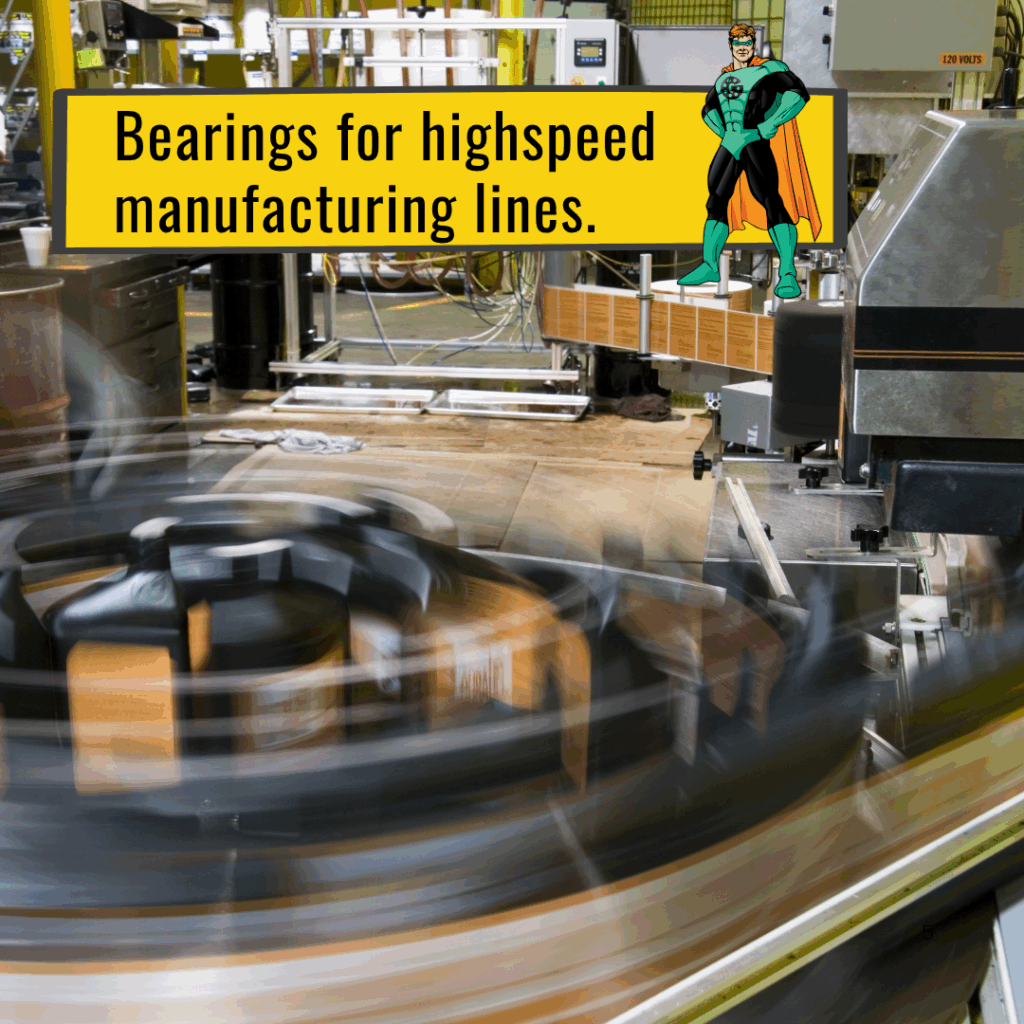
Bearings for High-Speed Manufacturing Environments: A Beginner’s Guide
Bearings for high-speed manufacturing keep industry spinning at thousands of revolutions per minute. If you’ve just landed on the trade desk or stepped onto your first factory floor, welcome to the fast lane — quite literally.
From bottling plants to CNC machines, these bearings handle the heat, pressure, and pace that standard bearings can’t. Get the spec wrong and the whole line can come to a halt.
This guide is here to help junior engineers, apprentices, and trade desk staff get their spec game up to speed. No wading through tech jargon or fluff, just the facts, a few pro tips, and everything you need to keep fast-moving kit rolling.
What are Bearings for High-Speed manufacturing — and Why Do They Matter?
Bearings for High-Speed Manufacturing are built to do one thing better than the rest: rotate fast, reliably.
We’re talking 10,000 RPM and beyond. You’ll find them in:
- CNC machines.
- Food and drink bottling lines.
- Packaging and labelling units.
- High-speed electric motors.
They’re critical for:
- Minimising friction.
- Handling high loads at high speeds.
- Maintaining alignment under pressure.
They’re not just spinning for the sake of it. At those speeds, even a tiny failure — heat build-up, lube breakdown, or a misaligned shaft — can bring down the line.
High-speed bearings reduce friction, maintain alignment, and hold their nerve under serious pressure. That’s why spec matters.
The Core Features of bearings for High-Speed manufacturing
Not all bearings can handle speed. These can, and here’s why:
Materials
- Chrome/Steel: Strong and heat-tolerant, but heavier.
- Ceramic (Silicon Nitride): Lightweight, low-friction, heat-resistant making them ideal for high RPM and lower thermal expansion.
Cages
- Polyamide: Lightweight and flexible, good for motor bearings.
- Metal: More durable under heat, ideal for industrial loads.
Seals vs Shields
- Sealed bearings: Keep contamination out prevent lube loss. Great for hygiene zones.
- Shielded bearings: Lower friction, better for clean, hot environments.
Pro tip: Never assume a shielded bearing is sealed. They’re different beasts and choosing the wrong one can ruin your weekend.
Speed Ratings for bearings for high-speed manufacturing – Know Your Limits
Every bearing has a maximum rated speed — push past it, and you’re asking for trouble.
Here’s what to check:
- Dynamic Load Rating (C)
- Speed Factor (n × dm) – RPM × mean bearing diameter.
- Lubrication type – Oil handles heat better than grease.
- Material and Clearance – Ceramic and C3/C4 clearance preferred.
Pro Tip: It’s important to understand that exceeding a bearing’s rated speed isn’t just about going too fast. It’s about thermal runaway, lubricant breakdown, and mechanical stress. For instance, in high-speed canning lines, even a 5% overrun on rated RPM can produce a heat curve that pushes grease out of contact zones within hours. This leads to metal-on-metal contact, increasing wear and reducing bearing life dramatically. Junior engineers often focus on load capacity, but at high speeds, thermal management becomes just as critical.
Never run a bearing at its absolute max speed — aim for 80–90% for safety and lifespan.
Example: On a canning line running 12,000 RPM, a bearing rated for 13,000 might technically work, but heat build-up will shred the grease in hours. That means metal-on-metal contact, vibration, and early failure.
Lubrication — Get It Wrong and You're Toast
Heat, friction, and high RPM eat grease for breakfast. You need:
- Low-viscosity lubricants for speed.
- Consistent application to prevent dry spots.
- NSF H1 grade in food zones
Grease vs Oil for bearings for high-speed manufacturing
Heat, friction, and high RPM eat grease for breakfast. You need:
- Low-viscosity lubricants for speed.
- Consistent application to prevent dry spots.
- NSF H1 grade in food zones
Factor | Grease | Oil |
Cooling | Poorer | Excellent |
Maintenance | Lower | Higher (needs pumps/filters) |
Application speed | Fine for most uses | Best for ultra-high-speed spindles |
Auto-lube systems like Perma keep lubrication consistent, reduce manual maintenance, and protect bearings even during night shifts.
Pro tip: The choice between grease and oil lubrication in high-speed applications deserves a second look. While grease is easy to handle and reduces leakage risks, oil provides better cooling and is often recirculated in high-performance systems. Many high-speed spindles, for example, are oil-lubricated with integrated filtration. In setups where downtime costs thousands per hour, the extra complexity of oil systems is justified by longevity and reliability.
However, for less intense environments like secondary packaging. A well-chosen grease in a Perma unit may outperform oil when maintenance access is limited. The key is knowing your line and balancing performance with practical upkeep.
Can It Take the Heat? Temperature Tolerance Matters
Friction = heat. And heat kills bearings faster than a misaligned shaft.
Look for:
- Greases rated 200–250°C.
- Ceramic hybrids for extreme duty.
- Floating mountings or expansion sleeves for thermal expansion.
In rapid stop-start environments, cyclic heat builds thermal gradients inside the housing. Over time, this causes fretting corrosion and these tiny surface cracks shorten life.
Design with thermal movement in mind. A few mm of float = hours saved on rebuilds.
Pro tip: Another key aspect is understanding thermal gradients across the bearing housing. In high-speed operations, especially where system stopping and starting is frequent, bearings are exposed to cyclic thermal stress. This can lead to micro-movements between the bearing and housing, causing fretting corrosion.
Over time, even the best materials degrade without proper thermal buffering. That’s why many high-speed designs incorporate expansion sleeves or floating bearing positions. The allow for slight axial movement to accommodate thermal elongation. It’s a small design tweak that delivers big protection in fast, hot environments.
What Goes Wrong with bearings for high-speed manufacturing – And How to Avoid It
Bearings for High-Speed Manufacturing don’t fail randomly. Here’s what to watch:
Most Common Causes
- Overloading
- Grease starvation
- Contamination
- Poor alignment
- Excessive preload
Prevention Checklist
✅ Correct speed rating
✅ Use proper mounting tools (no hammers)
✅ Maintain lube schedule
✅ Check for misalignment
✅ Avoid mismatched brands or part numbers
Install tip: Never wipe away the factory grease at the bearing edge as it’s part of the sealing barrier.
Pro tip: Contamination often gets blamed on the environment. But more often, it’s poor installation that invites the problem. High-speed bearings are particularly sensitive to ingress because even microscopic debris can become a high-velocity projectile inside the raceway.
That means every seal and shield must be properly seated. During install, avoid wiping grease off the factory-sealed edge. It might look messy, but that layer is a critical barrier. Also, never install bearings with pneumatic tools unless designed for it. The shock load can deform the cage subtly, leading to uneven roller loading at speed which eventually shows up as vibration, then failure.
What Goes Wrong – And How to Avoid It
Ask these before you spec:
- What’s the max RPM?
- Is there washdown or dust?
- What’s the temperature range?
- Is audit documentation needed?
- Any hygiene or food safety requirements?
Ask these before you spec:
- What’s the max RPM?
- Is there washdown or dust?
- What’s the temperature range?
- Is audit documentation needed?
- Any hygiene or food safety requirements?
Quick Reference Table
Requirement | Recommended Bearing Type |
15,000+ RPM | Ceramic hybrid bearing |
Daily washdowns | Sealed stainless steel unit (IP66+) |
Food contact | NSF H1 grease + sealed unit |
Audit traceability | Fully documented bearing specs |
No time for breakdowns | Auto-lube system (e.g. Perma) |
Trade-Desk Wisdom – From the People Who’ve Seen It All
- Don’t mix bearing brands unless you match specs exactly.
- Stock your spares — waiting 48 hours isn’t an option at 10k RPM.
- Log every replacement — your audit trail depends on it.
- Use sloped mounting pads — flat surfaces pool water.
- Any hygiene or food safety requirements?
Pro tip: Remember that new doesn’t mean ready. Bearings might sit in warehouse storage for months or even years. Before installation, inspect the packaging for moisture signs and rotate the bearing gently by hand. If it feels gritty or stiff, reject it. A single damaged bearing can bring down an entire line, and it’s often easier to check at the bench than under pressure on shift. Get into the habit of pre-checks, even when time’s tight.
Bearings Checklist for High-Speed Manufacturing Environments
Stick this to the bench:
✅ Ceramic or stainless materials
✅ Correct RPM and load rating
✅ High-temp grease
✅ Sealed or shielded correctly
✅ Mounted on sloped, clean surfaces
✅ Auto-lubed if possible
✅ Fully documented for audit
This saves shifts. And reputations.
Conclusion: Small Part, Massive Consequences
In high-speed manufacturing, bearings don’t just matter — they’re mission-critical.
Spec wrong and you’ll feel it in the pocket, in the production stats, and in the downtime log. But get it right, and you’ll keep the line turning, the auditors smiling, and the team on track.
For new starters, this guide gets you off the ground. For experienced hands, it’s a refresher with a few hard-earned tricks.
Explore our [overview guide on manufacturing bearings] or check out our [food-safe stock range] if hygiene matters too.
Contact us today for help with speccing and ordering the parts you need.
To view the entire range of bearings for high-speed manufacturing, log in or create an account to our Sales Portal.

TOM HAMLETT
Tom Hamlett is a respected authority in the global bearings marketplace, with over 35 years of experience in industrial bearings, lubricants, and adhesives across a wide range of industries. As Managing Director of Godiva Bearings, Tom has built a trusted business renowned for its commitment to quality, technical expertise, and ethical service. Under his leadership, Godiva Bearings has remained the UK’s only trade-exclusive bearings supplier, proudly serving engineers and distributors worldwide since 1977. Tom’s in-depth knowledge and dedication have cemented his reputation as one of the most knowledgeable figures in the sector.