
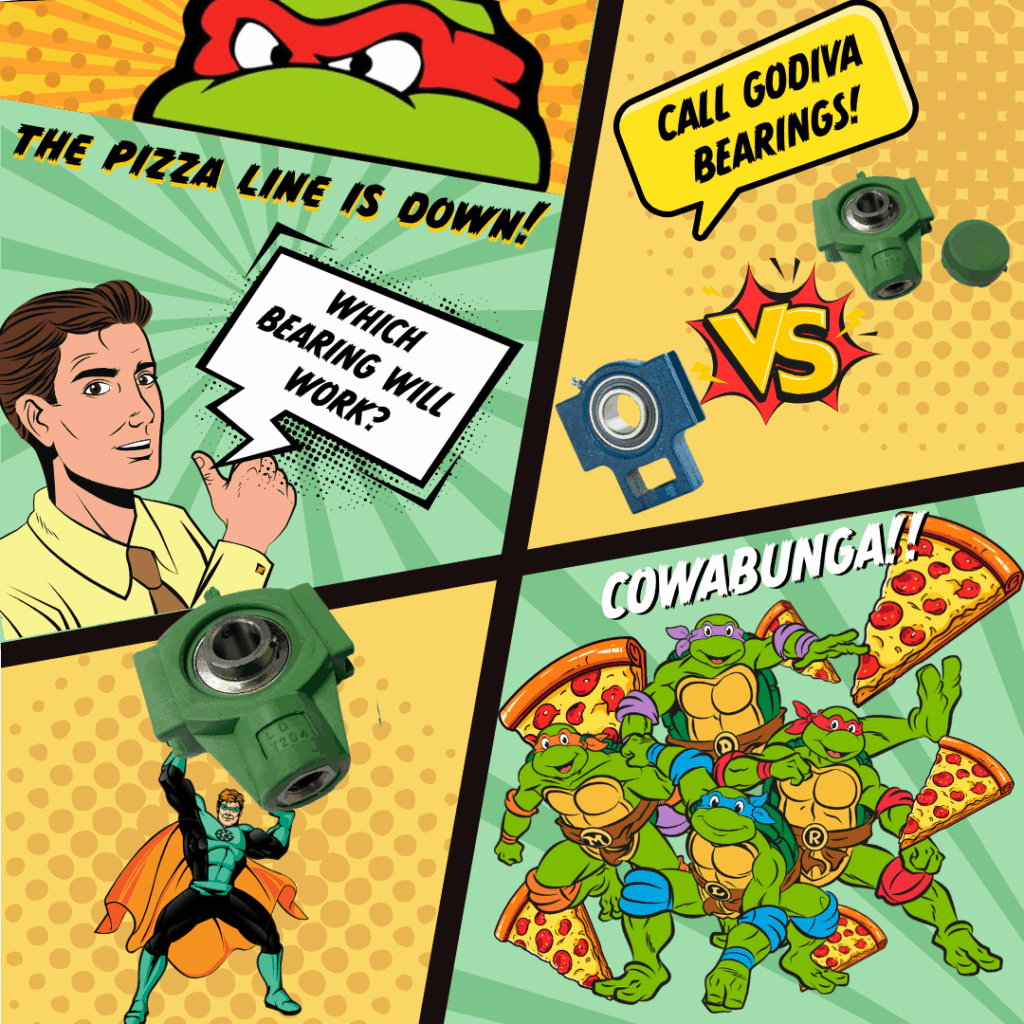
Food Factory Bearings vs. Everything Else
Why standard bearings don’t cut it on the line – and how to choose ones that do.
Not All Bearings Are Created Equal
Bearings may all look like shiny metal donuts, but when it comes to food production. They’re as different as a steak bake and a vegan sausage roll. Swap in a standard bearing on a food line and you’re flirting with disaster — contamination, downtime, ruined batches, and the dreaded product recall.
In this post, we’re breaking down exactly why food factory bearings are a different breed — and how to avoid costly mistakes by choosing the right spec.
Want the full technical deep dive? Read The Complete Guide to Bearings in Food Production.
What Makes Food Factory Bearings So Different?
At first glance, a bearing is a bearing. But in food production, it’s what’s inside, around, and on that bearing that makes all the difference. You’re not just managing movement — you’re managing hygiene, safety, temperature, cleaning cycles, and compliance.
Here’s a deeper dive into what truly separates a food-safe bearing from a standard industrial one.
Sealing & Hygiene: The First Line of Defence.
In a typical industrial setting, an open or shielded bearing might last a while with regular greasing. In food production? It wouldn’t last a shift.
Food-safe bearings are fully sealed, often with multi-lip or labyrinth-style seals, designed to keep out water, steam, dust, and even cleaning chemicals. The goal is to create a self-contained system that:
- Prevents contamination of the bearing from the outside.
- Stops grease leaking out into food zones.
- Survives aggressive washdowns with high-pressure jets and caustic detergents.
Most food-grade units also meet IP66 or IP69K ratings — meaning they can handle direct spray from industrial cleaning equipment without letting a single droplet in.
Think of it like this: a standard bearing wears a cotton T-shirt in a monsoon. A food-safe bearing wears a full hazmat suit.
Materials Built for the Food Production Environment.
Food factories are hostile environments for the wrong kind of metal. Moisture, acidity, salt, and rapid temperature changes can destroy untreated bearings in no time.
That’s why food-grade bearings are usually made from:
- Stainless steel (typically 304 or 440 grade): resistant to rust, acids, and cleaning chemicals.
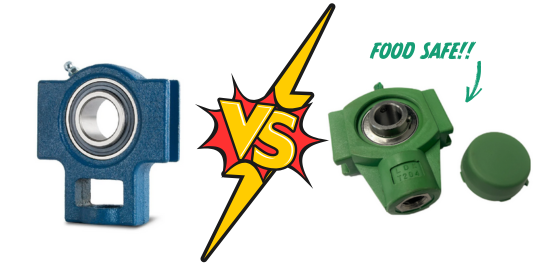
- Polymer housings: ideal for low-friction, corrosion-resistant installations that need to be lightweight or non-metallic.
- Plated or coated components: such as nickel-plated inserts or ceramic coatings for specialist environments
And it’s not just the outer material — even cages and seals are made with hygiene and resistance in mind. Rubber seals are often FDA-approved elastomers, and cages might be made from polymer or stainless materials too.
Food-Grade Lubrication That Stays Put.
Here’s where it gets critical. In a food factory, grease matters — and not just because of performance.
Food-safe bearings must use NSF H1-approved lubricants, which are safe for incidental food contact. That means if a tiny bit of grease escapes the bearing and ends up in or near food, it won’t cause a safety incident, failed audit, or recall.
These lubricants are:
- Stable at high and low temps
- Resistant to washout
- Odourless, tasteless, and non-toxic
Even better? Many bearings in food applications now rely on automatic lubrication systems like Perma, which eliminate human error, reduce downtime, and ensure consistent lubrication — especially in hard-to-reach zones or 24/7 operations.
Discover Perma’s FOOD LUBE solutions.
Certification & Compliance You Can Count On in Food Production.
You might not see it at a glance, but compliance is built into a food-safe bearing.
Leading manufacturers design their bearings to meet global food safety regulations such as:
- NSF H1 & H2
- FDA food contact safety
- EU Regulation 1935/2004 (for materials intended to come into contact with food)
These certifications are critical for:
- Passing audits with supermarkets, safety bodies and third-party quality assessors
- Ensuring traceability in the event of a hygiene or safety issue
- Meeting supplier standards in sectors like dairy, meat, bakery, and frozen foods
Some bearings also feature traceable laser markings, serialisation or supporting documentation for chain-of-custody requirements — especially in larger processing facilities.
In short: food-safe bearings aren’t just functional. They’re legally fit for purpose.
The Risks of Using ‘Standard’ Bearings in Food Plants.
Using the wrong bearing might not seem like a big deal… until it is. Here’s what you’re risking:
- Rust and pitting in humid or washdown areas.
- Grease contamination from non-food-safe lubricants.
- Frequent failure, especially in hot, wet, or high-speed zones
- Line downtime and production delays.
- Failed audits, hygiene breaches, or worst case — product recalls
One failed bearing in a food line can cost up to £3,000/hour in lost production. Not to mention the damage to your client’s reputation.
Mistakes We See All the Time (and How to Fix Them).
 “It’s just a conveyor – any bearing will do”
 Not true. Choose insert units or polymer housings designed for washdown.
“I’ll re-grease it with what I’ve got in the van” Use only NSF H1 grease, or better yet – spec a Perma autolube unit.
“This one’s cheaper” And you’ll be replacing it every few weeks. False economy at its finest.
“They’ve never asked for food-safe before” Doesn’t mean they don’t need it. Be the expert — ask the right questions.
When Do You Really Need a Food-Grade Bearing?
Always spec for the worst-case scenario — because conditions change fast in a working food factory. You’ll definitely need food-grade if:
- The bearing is in or near a food contact zone.
- Equipment is subject to daily washdowns.
- There’s steam, heat, or chilling involved.
- The machine runs continuously.
- It’s part of a critical production process.
Conclusion: Choose Smart or Pay Later!
In the world of food production, the wrong bearing isn’t just a minor issue — it can grind the whole operation to a halt.
Godiva Bearings stocks trusted food-safe products from manufacturers who know what real factories demand:
- LDK – food-safe polymer and stainless-steel housings and insert bearings.
- Perma – NSF Food safe auto-lubrication systems.
- Ambersil – NSF-grade maintenance sprays.
- Schaeffler – ING and FAG food housings and stainless-steel bearings
Need help choosing the right spec? Read The Complete Guide to Bearings in Food Production or give us a call, we’re here 24/7/365 to help keep your food production line moving.

TOM HAMLETT
Tom Hamlett is a respected authority in the global bearings marketplace, with over 35 years of experience in industrial bearings, lubricants, and adhesives across a wide range of industries. As Managing Director of Godiva Bearings, Tom has built a trusted business renowned for its commitment to quality, technical expertise, and ethical service. Under his leadership, Godiva Bearings has remained the UK’s only trade-exclusive bearings supplier, proudly serving engineers and distributors worldwide since 1977. Tom’s in-depth knowledge and dedication have cemented his reputation as one of the most knowledgeable figures in the sector.