
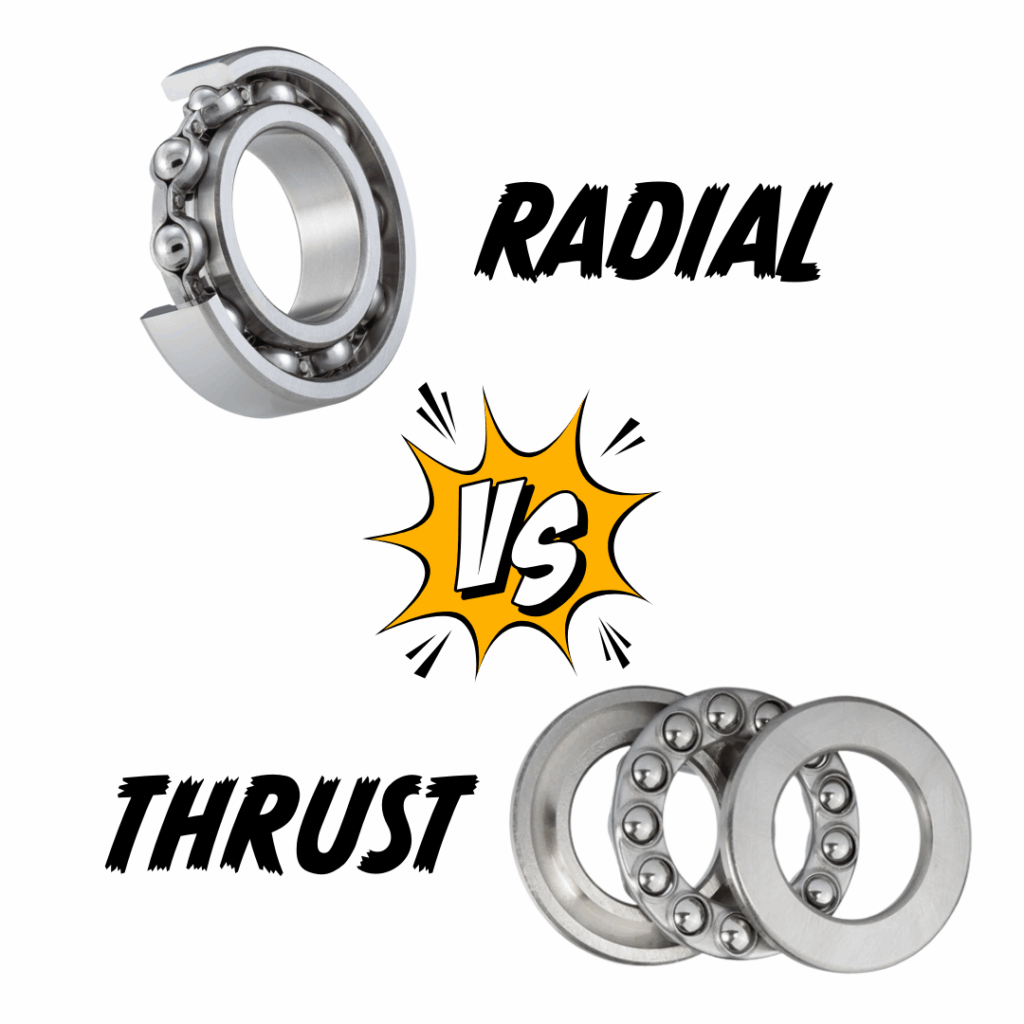
Radial vs Thrust Bearings: A No-Nonsense Guide for the Trade Desk
If you’re new to the parts desk or guiding engineers through specs, the phrase “radial vs thrust bearings” pops up often. And it’s not just wordplay. Knowing the difference helps you get the right part, first time – no returns, no repeat calls.
This quick guide breaks down the basics so you can steer confidently through bearing enquiries. Whether you’re helping someone fix a conveyor or sort a press, the load direction matters more than the size. We’ll show you how to tell them apart, when to use each, and why it pays to spec smart.
At Godiva Bearings, we only supply the trade – no consumers, no distractions. Just the stock, knowledge and support you need to keep things moving.
What Are Radial Bearings?
- Handle loads perpendicular to the shaft
- Common in motors, pumps, fans, and conveyor rollers
- Often deep groove ball bearings
Radial bearings support what most people think of as “standard” motion. They deal with rotation around a central axis and are the go-to for shafts that spin under load.
Spot them:
- Load is applied at a right angle to the shaft
- Typically, compact and versatile
What Are Thrust Bearings?
- Handle loads parallel to the shaft
- Found in vertical shafts, turntables, and screw jacks
- Come in ball, roller, or tapered forms
Thrust bearings take the weight or force along the axis. Think pushing rather than spinning. They’re built to handle pressure that tries to drive components apart along the shaft line.
Spot them:
- Load pushes directly in line with the shaft
- Usually wider and flatter than radial types
Radial vs Thrust Bearings: Key Differences
Feature | Radial Bearing | Thrust Bearing |
Load Direction | Perpendicular | Parallel |
Applications | Motors, conveyors | Jacks, spindles |
Shape | Deep groove, narrow profile | Flat, wide raceways |
Misuse Consequences | Early failure, overheating, | Axial movement, damage. |
If a bearing isn’t matched to the direction of force, it won’t last long. Wrong spec = early call-out.
Radial vs Thrust Bearings Mixed Load Applications
Some machines throw a curveball: both radial and thrust loads. Here you need bearings that can do both.
Common solutions:
- Angular contact bearings – take both radial and axial loads
- Tapered roller bearings – ideal for combined load situations
Where you see them:
- Gearboxes
- Wheel hubs
- Vertical pumps
Always clarify the dominant load direction when choosing.
Radial vs Thrust Bearings FAQs from the Trade Desk
“Can I swap a thrust for a radial?”
No. They’re built for different forces. A radial bearing won’t last long under axial load, and a thrust bearing can’t take side loads well. You’ll risk early failure, damage to adjacent components, and unwanted returns.
“Can one bearing handle both?”
Sometimes. Angular contact bearings and tapered roller bearings can manage both radial and thrust loads. But it depends on the ratio of forces and the application. Always check spec sheets and clarify what direction dominates.
“How do I tell the difference?”
Ask the right question: “Which direction is the force coming from?”
- If it’s side-to-side, it’s radial.
- If it’s straight along the shaft, it’s thrust.
- If it’s both, look into combined-load bearings.
Also look at the shape: radial bearings tend to be more compact, while thrust bearings are flatter and wider to spread the axial load.
“What happens if I use the wrong one?”
- A radial bearing in a thrust load can overheat, wear unevenly, or even crack.
- A thrust bearing in a radial load will show signs of misalignment, fast fatigue, or seal failure.
Worst case? You’ll hear about it at 2am when a machine fails mid-shift. Get it right upfront.
“What’s the biggest giveaway I’ve got the wrong spec?”
- Repeated failures in the same place.
- Grease escaping under pressure.
- Noisy operation under load.
- Visible scoring or unusual wear patterns on the raceways.
If a bearing keeps coming back with the same issue, check the load direction and whether it matches the bearing’s design.
“Is this something the end user should figure out?”
No. That’s why they call the trade. As a distributor, your edge is knowing what fits, what works, and what avoids downtime. That’s where we come in too – helping you spec it right the first time.
Trade Only Support from Godiva Bearings
When your customer’s line is down, the last thing you need is a supplier quoting retail prices or offering “similar” parts to the public. At Godiva Bearings, we’re 100% trade only.
- No public Web shop.
- No public pricing.
- No end-user sales.
Just fast-moving stock, sharp technical advice, and real humans on the phone 24/7.
Explore more:
Conclusion
Understanding the difference between radial and thrust bearings is key to fast, accurate support at the trade desk. It’s not about sounding clever – it’s about getting the job done right, first time.
If you’re ever unsure, ask about the load direction. That single question can save hours of guesswork, returns, and downtime.
Need help specifying a bearing for a tricky application? Call our team. We’ve been doing this since 1977 and only deal with the trade. No scripts. No bots. Just humans who get it.
Contact Godiva Bearings or explore our full range of stock and support

TOM BERRY
With over 20 years experience in the Bearings distribution trade (most of which has been spent at Godiva Bearings) Tom has a vast knowledge of the complete Godiva Bearings product range. He overseas all product marketing (all 65000 products!) and the online sales portal.